
4 benefits of vitamin A for the skin
Vitamin A, an essential nutrient for the human body, has a number of scientifically recognized effects, particularly on the skin. In this article, we take a look at four major areas in which vitamin A has an effect on the skin.


The central role of vitamin A for the body and the skin
Vitamin A is actually a generic term for several compounds. Its main forms are retinoids (retinol, retinal, retinoic acid) and carotenoids (including beta-carotene, the precursor of vitamin A).
In the body, they are transformed into active molecules, which help to regulate key functions (1).
The different forms of vitamin A are fat-soluble and can be easily found in a variety of everyday foods (liver, dairy products, oily fish, orange and green vegetables, etc.).
If necessary, vitamin A can also be consumed via food supplements.
 Discover the Carottol™ dietary supplement, a complex of natural carotenoids, particularly rich in beta-carotene.
Among its benefits, vitamin A helps to maintain normal skin and mucous membranes. This is why it is often used in dermatology.
We will now look in detail at the four main biological mechanisms behind vitamin A's effects on the skin.
1. Vitamin A and skin cell renewal
According to scientific research, vitamin A appears to play a major role in the natural skin cell renewal cycle.
In fact, it is involved in the process of cell specialisation, which means that it helps to orientate skin cells towards their final function.
More specifically, it helps keratinocytes, the main cells of the epidermis, to form correctly in the deep layers of the skin, and then to progressively evolve towards the skin's surface (2).
This mechanism is thought to help maintain a supple, homogenous and functional epidermis.
Some research also suggests that vitamin A, in particular retinoids and beta-carotene, may promote skin repair following environmental stressors, such as repeated exposure to UV rays (3-4).
2. A potential influence on collagen production
Collagen is a major structural component of the skin: it is a fibrous protein present in the extracellular matrix, which ensures the solidity, elasticity and firmness of the dermis.
Several scientific studies suggest that vitamin A and its derivatives (retinoids) may stimulate the activity of fibroblasts. These are the cells responsible for producing collagen in the dermis.
An in vitro study on fibroblasts showed that adding vitamin A or retinoic acid to tissue cultures induced cell differentiation, with increased collagen accumulation (5).
So far, these beneficial effects have been observed in experimental models, but have not been confirmed in humans under physiological conditions.
While vitamin A could help to maintain skin firmness and elasticity by influencing collagen synthesis, these effects require further research before they can be fully established.
3. Vitamin A and the fight against oxidative stress
Vitamin A and its precursors, such as beta-carotene, help to protect cells against oxidative stress.
This role is explained by their ability to neutralize certain reactive oxygen species, known as free radicals, produced in particular by exposure to UV rays, pollution or smoking (6-7).
By limiting oxidative stress, vitamin A could help to slow down certain mechanisms involved in photo-aging of the skin (8).
Photo-aging results in a loss of suppleness and the appearance of wrinkles, fine lines and pigmentation spots linked to chronic exposure to the sun.
However, vitamin A is not a miracle cure for UV-induced skin aging.
Improving skin condition in this particular context also depends on other factors:
- level of sun exposure and protective measures taken
- overall lifestyle (smoking, diet, exposure to pollution, stress)
- balance of overall antioxidant intakes other than vitamin A
In this way, vitamin A could help to strengthen the skin's defenses against free radicals, but its optimum effectiveness can only be envisaged as part of an overall intake of varied antioxidants.
4. A supposed role in regulating sebum production
According to some dermatological studies, vitamin A could influence the activity of the sebaceous glands, responsible for sebum production.
This lipid film, naturally present on the skin's surface, plays a protective role. In the right quantities, it helps to keep the skin moisturised and protect it from external stressors.
Conversely, too much sebum can encourage the appearance of imperfections, while too little leads to dry, fragile skin.
Scientific studies have shown that retinoic acid modulates the activity of the sebaceous glands and can reduce their size and secretion. This explains its medical use in certain skin conditions associated with hyperseborrhoea, such as acne (9-11).
These observations suggest that, when taken in pharmacological doses, vitamin A may play a role in maintaining the seborrhoeic balance, helping to keep skin neither too dry nor too oily.
Sources of vitamin A and precautions to take before using it on the skin
Foods rich in vitamin A
Vitamin A exists in two main forms: retinol and its derivatives (active form of animal origin) and carotenoids (precursors of vitamin A, of plant origin).
Foods rich in retinol include:
- beef, poultry or cod liver
- butter and full-fat dairy products
- eggs (especially the yolk)
- oily fish (salmon, mackerel, sardines)
The foods richest in beta-carotene include:
- carrots
- sweet potatoes
- spinach and kale
- squash
- apricots and mangoes
Finally, to find other carotenoids that can be used by the body, you can turn to:
- papaya
- red peppers
- citrus fruit
- maize
What you need to know about vitamin A supplementation
Supplementation can help to increase vitamin A intake, particularly where there is a risk of deficiency or to support the skin.
However, it is important to bear in mind that too much vitamin A (particularly in the form of retinol) can become toxic, particularly during pregnancy, leading to liver, neurological or skin disorders.
It is therefore essential to follow medical recommendations before taking any supplements.
Food supplements may contain only vitamin A and its derivatives.
Discover the Carottol™ dietary supplement based on beta-carotene and other carotenoids.
It can also be incorporated into multi-vitamin complexes to benefit from the synergistic action of several vitamins and minerals.
Discover the Daily 3® food supplement, a complete formula containing vitamin A in the form of carotene and palmitate.
Vitamin A is also a key ingredient in dietary supplements for sun protection and preparing the skin for tanning.
Discover Solar Prep Formula, a food supplement that combines different carotenoids (beta-carotene, lutein, lycopene) and ingredients studied for their effects on skin health.
Other ingredients potentially good for the skin
Skin health does not, of course, depend solely on vitamin A. Other nutritional supplements contain ingredients with documented skin health benefits.
Discover the Natural Skin Formula food supplement, a unique formulation containing hyaluronic acid, collagen, elastin and ceramides, or the Daily Beauty supplement, a complete formula based on various ingredients studied in the context of skin beauty.
Evening primrose oil and borage oil, rich in fatty acids, are among the active ingredients often found in food supplements for the skin.
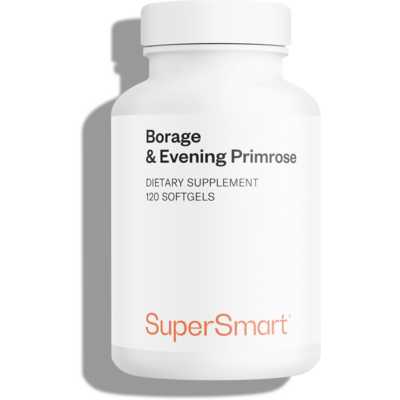
Discover the Borage & Evening Primrose food supplement, which contains these two ingredients as well as vitamin E.
Finally, it is also possible to consume collagen orally.
Discover the food supplement Marine Collagen, our excellent marine collagen powder, in the form of hydrolyzed peptides of type 1 collagen.
SUPERSMART ADVICE

References
- Carazo A, Macáková K, Matoušová K, Krčmová LK, Protti M, Mladěnka P. Vitamin A Update: Forms, Sources, Kinetics, Detection, Function, Deficiency, Therapeutic Use and Toxicity. Nutrients. 2021 May 18;13(5):1703. doi: 10.3390/nu13051703. PMID: 34069881; PMCID: PMC8157347.
- Chopra DP, Flaxman BA. The effect of vitamin A on growth and differentiation of human keratinocytes in vitro. J Invest Dermatol. 1975 Jan;64(1):19-22. doi: 10.1111/1523-1747.ep12540883. PMID: 1167216.
- Polcz ME, Barbul A. The Role of Vitamin A in Wound Healing. Nutr Clin Pract. 2019 Oct;34(5):695-700. doi: 10.1002/ncp.10376. Epub 2019 Aug 7. PMID: 31389093.
- Mukherjee S, Date A, Patravale V, Korting HC, Roeder A, Weindl G. Retinoids in the treatment of skin aging: an overview of clinical efficacy and safety. Clin Interv Aging. 2006;1(4):327-48. doi: 10.2147/ciia.2006.1.4.327. PMID: 18046911; PMCID: PMC2699641.
- Demetriou AA, Levenson SM, Rettura G, Seifter E. Vitamin A and retinoic acid: induced fibroblast differentiation in vitro. Surgery. 1985 Nov;98(5):931-4. PMID: 4060071.
- Baek J, Lee MG. Oxidative stress and antioxidant strategies in dermatology. Redox Rep. 2016 Jul;21(4):164-9. doi: 10.1179/1351000215Y.0000000015. Epub 2016 Mar 31. PMID: 26020527; PMCID: PMC8900706.
- Didier AJ, Stiene J, Fang L, Watkins D, Dworkin LD, Creeden JF. Antioxidant and Anti-Tumor Effects of Dietary Vitamins A, C, and E. Antioxidants (Basel). 2023 Mar 3;12(3):632. doi: 10.3390/antiox12030632. PMID: 36978880; PMCID: PMC10045152.
- Pandel R, Poljšak B, Godic A, Dahmane R. Skin photoaging and the role of antioxidants in its prevention. ISRN Dermatol. 2013 Sep 12;2013:930164. doi: 10.1155/2013/930164. PMID: 24159392; PMCID: PMC3789494.
- Leyden JJ, McGinley KJ. Effect of 13-cis-retinoic acid on sebum production and Propionibacterium acnes in severe nodulocystic acne. Arch Dermatol Res. 1982;272(3-4):331-7. doi: 10.1007/BF00509064. PMID: 6219631.
- Strauss JS, Stranieri AM, Farrell LN, Downing DT. The effect of marked inhibition of sebum production with 13cis-retinoic acid on skin surface lipid composition. J Invest Dermatol. 1980 Feb;74(2):66-7. doi: 10.1111/1523-1747.ep12519851. PMID: 6444323.
- Nelson AM, Zhao W, Gilliland KL, Zaenglein AL, Liu W, Thiboutot DM. Neutrophil gelatinase-associated lipocalin mediates 13-cis retinoic acid-induced apoptosis of human sebaceous gland cells. J Clin Invest. 2008 Apr;118(4):1468-78. doi: 10.1172/JCI33869. PMID: 18317594; PMCID: PMC2262030.





17 Hours
Products that work
Products that work
William Hegel
22 Hours
Product arrived in a timely fashion and…
Product arrived in a timely fashion and in good condition.
NELSON Jerry
2 Days
Product effectiveness
Quick delivery. Giving product 90 days to see if there are any positive changes. Starting days 31-60
Bob L
6 Days
Easy to order products
Easy to order products
Edward P
10 Days
correct product arrived on time
The product arrived on time and appears to be what I ordered (i do not perform any tests outside of my own experience). I have used this Bacillus Subtills for quite over a year, and I am convinced of it's contribution to my microbiome. The product and business model work well.
Lisa
10 Days
All the supplements are of great…
All the supplements are of great quality and they have almost anything you could need
kirstin Torres
10 Days
Easy to order, fast delivery
Easy to order, fast
Sissy Lawson
14 Days
What luck to come across such a clean…
What luck to come across such a clean brand! No bad ingredients in these and a reasonable price for what we're getting.
Bindi S
15 Days
The best supplement for…
The best supplement for hyperpigmentation or melasma. I have struggled with melasma and hyperpigmentation for 10 years. I have tried everything, including lasers. Nothing really worked except this!
NS
18 Days
Great source for high quality…
Great source for high quality supplements
Vikki L
20 Days
Recommended: "Eye Pressure"
(Eye Pressure pills) Highly recommended for glaucoma patients
LM
21 Days
Great follow-up
Great follow-up
Michael Henderson
25 Days
My hair isn't gray.
My hair isn't gray.
TANQUARY Damon
25 Days
The ease of ordering is not the only …
The ease of ordering is not the only reason why I trust Super Smart Supplements. This company researches everything they sell. Educating Me with a wealth knowledge to make Better Supplement choices. The paractin Andrographis is awesome! I noticed less Knee, shoulder or joint pain. Which proves to me, you're never too old to repair what a lifetime of intense usage has done to your body. I recommend SUPER SMART to anyone who is looking to improve their overall health & maintain an active ,pain free life as You age.
Mchael Montalbano
28 Days
Quick shipping and very good quality
Quick shipping and very good quality. I’ve bought from them for the last six months
Monig