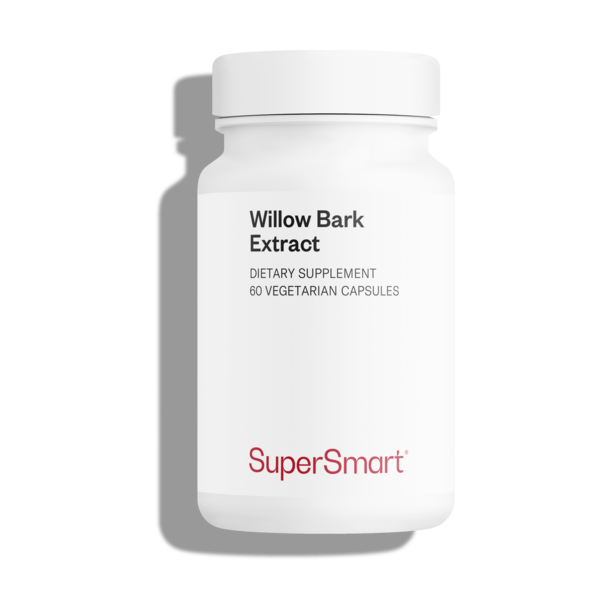
Willow Bark Extract is a botanical supplement derived from the bark of the white willow tree (Salix alba). It provides naturally occurring salicin along with plant polyphenols and flavonoids traditionally studied for their role in supporting overall physical comfort and well-being as part of a balanced lifestyle.*
What is White Willow Bark?
White willow (Salix alba) is a tree species native to Europe and parts of Asia. For centuries, preparations made from its bark have appeared in traditional botanical practices across many cultures.*
The bark naturally contains salicin, along with numerous plant compounds including flavonoids, proanthocyanidins, flavanones, and polyphenols. These compounds are frequently studied for their roles in plant physiology and their interactions with human biological pathways.*
Plant Compounds Naturally Found in Willow Bark
White willow bark contains a diverse profile of phytonutrients. These include:
- Salicin, a naturally occurring plant compound historically identified in willow bark.*
- Flavonoids such as catechin and dihydroquercetin.*
- Flavanones including naringenin and eriodictyol.*
- Polyphenols such as caffeic, ferulic, cinnamic, and coumaric acids.*
- Proanthocyanidins, plant compounds that are widely distributed in botanical sources.*
These compounds have been the subject of ongoing scientific investigation for their potential biological activity and interactions with normal physiological processes.*
Scientific Interest in Willow Bark Compounds
Researchers have long been interested in the naturally occurring compounds present in willow bark and their role in plant chemistry.*
Salicin and related phytochemicals have been studied for how they interact with metabolic pathways in laboratory and clinical research settings. As with many botanical compounds, scientific understanding continues to evolve as new studies are published.*
Why Consider Willow Bark Extract?
Willow bark extract is used today as a source of naturally occurring plant phytonutrients. Standardized extracts provide a consistent level of salicin while preserving the broader profile of plant compounds naturally present in the bark.*
This botanical supplement may be of interest to individuals seeking plant-derived compounds as part of a balanced wellness routine.*
Suggested Use
The suggested use is 1–2 capsules per day with meals, or as directed by a qualified healthcare professional.*
Precautions
As with any dietary supplement, individuals who are pregnant, breastfeeding, taking medications, or managing a medical condition should consult a qualified healthcare professional before use.*
Individuals with known sensitivities to salicylate-containing substances should also seek professional advice prior to supplementation.*
WARNINGS
Do not exceed the recommended daily dose. This product is a nutritional supplement and should not be used as a substitute for a varied and balanced diet or a healthy lifestyle.
STORAGE
Store in a cool, dry place away from direct sunlight, heat, and humidity.
Keep out of reach of children.
PREGNANCY AND MEDICAL CONDITIONS
If you are pregnant, breastfeeding, or have any medical conditions, consult your healthcare provider before using this product.
SUPPLEMENT INTERACTIONS
Consult your healthcare provider before use, especially if you are taking any medications or other supplements as there may be potential interactions.
*These statements have not been evaluated by the Food and Drug Administration. This product is not intended to diagnose, treat, cure, or prevent any disease.
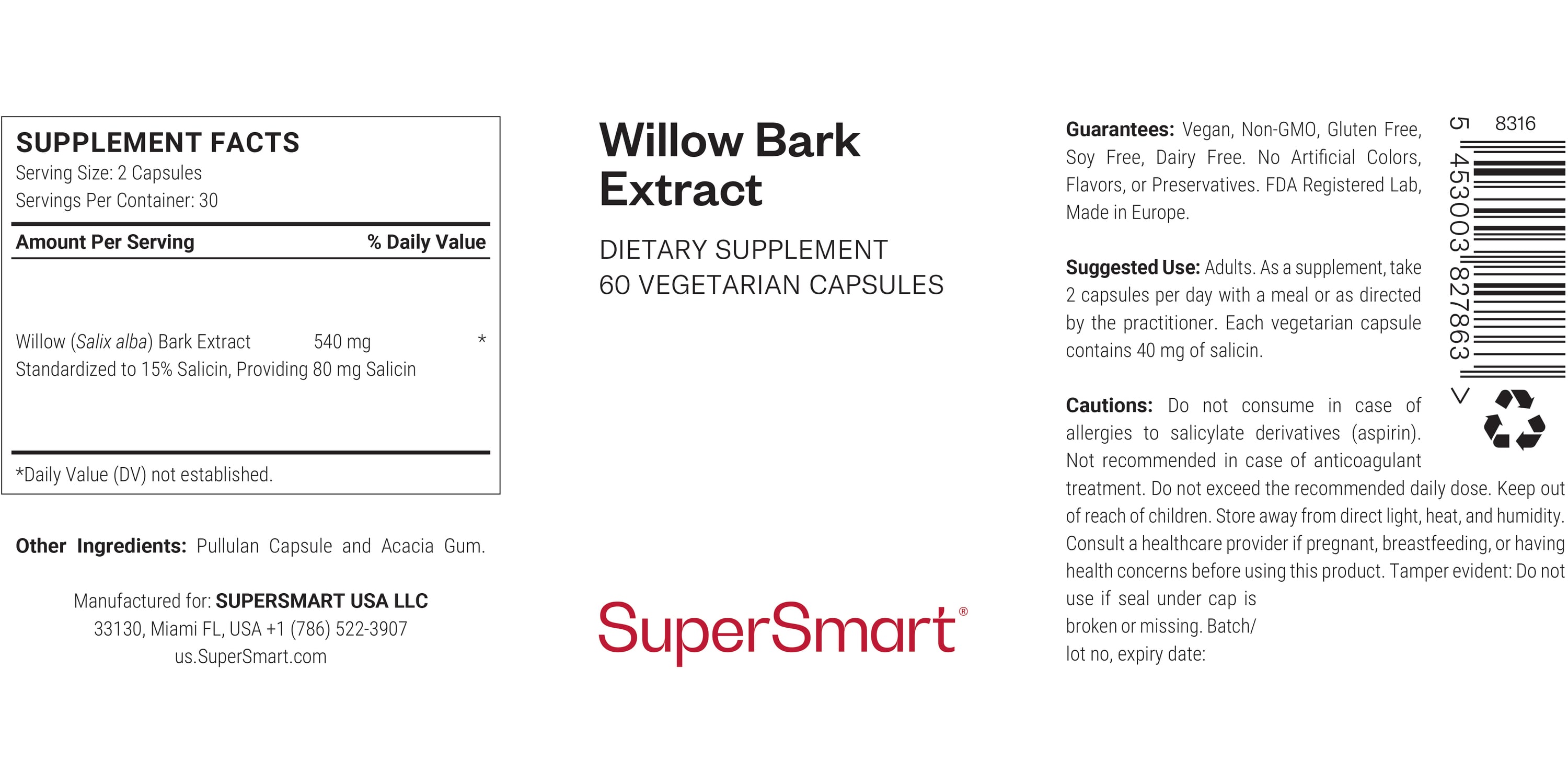
Serving Size: 2 Capsules
Servings Per Container: 30 |
Amount Per Serving |
Salicin
From 532 mg of Willow Bark Extract Standardized to 15% Salicin
|
80 mg |
|
Other Ingredients: Acacia Gum and Pullulan Capsule.
|
Serving size: Take 2 capsules a day. Each capsule contains 40 mg of salicin.
Servings per container: 30
Storage: Store away from direct light, heat, and humidity.
Warnings: Do not consume in case of allergy to salicylate derivatives (aspirin). Not recommended in case of anticoagulant treatment.
Cautions: For adults only. Do not exceed the recommended daily dose. Keep out of reach of children. Consult a healthcare provider before taking this supplement and if you are pregnant, breastfeeding, or having health concerns.*
This product is a dietary supplement and should not be used as a substitute for a varied, balanced diet and a healthy lifestyle.
- Lévesque H, Lafont O. 2000. Aspirin throughout the ages: a historical review. Rev. Med. Interne21(Suppl. 1), 8s–17s. (10.1016/S0248-8663(00)88720-2) [PubMed]
- Khayyal MT, El-Ghazaly MA, Abdallah DM, Okpanyi SN, Kelber O, Weiser D. Mechanisms involved in the ... of a standardized willow bark extract. Arzneimittel-Forschung. 2005;55(11):677–687.
- Pobłocka-Olech L, Krauze-Baranowska M, Głód D, Kawiak A, Łojkowska E. Chromatographic analysis of simple phenols in some species from the genus. Phytochemical Analysis. 2010;21(5):463–469.
- Jin, L., Zeng, W., Zhang, F., Zhang, C., Liang, W. 2017. Naringenin ... by regulating intracellular ... . J. Immunol. 199, 3466-3477.
- Lee, E., Jeong, K., W., Shin, A., Jin, B., Jnawali, H., N., Jun, B., H., Lee, J., Y., Heo, Y., S., Kim, Y. 2013. Binding model for eriodictyol to Jun-N ... signaling pathway. BMB Rep. 46, 594-599
- Highfield ES, Kemper KJ. 1999. White willow bark (S. alba). The Longwood Herbal Task Force, 1–12. http://www.mcp.edu/ herbal/default.htm
- Nahrstedt, A., Schmidt, M., Jäggi, R., Metz, J., Khayyal, M. T., 2007. Willow bark extract: the contribution of polyphenols to the overall ... . Wien. Med. Wochenschr. 157, 348–351.
- Schmid, B., Kötter, I., Heide, L. 2001. ... of salicin after oral administration of a standardised willow bark extract. Eur. J. Clin. Pharmacol. 57, 387–391.
- Blumenthal M, Goldberg A, Brinckmann J (Ed). Expanded Commission E Monographs, American Botanical Council, publié en collaboration avec Integrative Medicine Communications, États-Unis, 2000, p. 410.
- Wagner H. ... —the future of ... for more than just functional .... Phytomedicine. 2006;13(1):122–129.
- Berenbaum MC. What is synergy? Pharmacological Reviews. 1989;41(2):93–141.
- Williamson EM. Synergy and other ... in phytomedicines. Phytomedicine. 2001;8(5):401–409.
- Herbal medicine for ... : a Cochrane review. Gagnier JJ, van Tulder MW, et al. Spine. 2007 Jan 1;32(1):82-92. Review. Erratum in: Spine. 2007 Aug 1;32(17):1931.
- Biegert C, Wagner I, et al. ... of willow bark extract in the ... : results of 2 randomized double-blind controlled trials. J Rheumatol. 2004 Nov;31(11):2121-30.
- Beer AM, Wegener T. Willow bark extract (Salicis cortex) for ... - Results of a cohort study with a control group. Phytomedicine. 2008 Sep 22.
- Vlachojannis JE, Cameron M, Chrubasik S. 2009. A systematic review on the ... of willow bark for ... . Phytother Res 23: 897–900.
- Tohgi H, Konno S, Tamura K, Kimura B, Kawano K. 1992. ... of low-to-high doses of aspirin on ... and metabolites of thromboxane A2 and prostacyclin. Stroke 23, 1400–1403. (10.1161/01.STR.23.10.1400) [PubMed]
- Alfonso L, Ai G, Spitale RC, Bhat GJ. 2014. Molecular targets of aspirin and ... prevention. Br. J. ... 111, 61–67. (10.1038/bjc.2014.271)
- Zhu F, Xi DH, Yuan S, Xu F, Zhang DW, Lin HH. 2014. Salicylic acid and jasmonic acid are essential for systemic ... in Nicotiana benthamiana. Mol. Plant Microbe Interact 27, 567–577. (10.1094/MPMI-11-13-0349-R)
- Krivoy N, Pavlotzky E, et al. ... of salicis cortex extract on human platelet aggregation.Planta Med 2001 Apr;67(3):209-12.
- Steinegger E, Hovel H. 1972. Analytical and biological studies on Salicaceae substances, especially salacin. II. Biological study. Pharmaceut Acta Helv 47: 222–234.
- Monika Untergehrer , Josef Kiermaier , Susanne Reintjes , Jorg Heilmann , Guido J ¨ urgenliemk, Identification of phase-II metabolites from human serum samples after oral intake of a willow bark extract ¨ PII: S0944-7113(18)30560-9 DOI: https://doi.org/10.1016/j.phymed.2018.11.003 Reference: PHYMED 52742 To appear in: Phytomedicine