
Vitamin B2: Benefits and Dietary Sources
Vitamin B2, also known as riboflavin, was discovered in 1933 and is essential to our daily energy metabolism. But where can we find it in our food? That's what we'll be looking at in this article.


What is vitamin B2 (riboflavin)?
Riboflavin, or vitamin B2, is a water-soluble B vitamin that is involved in a number of enzymatic reactions.
Although the body produces small quantities, these are insufficient to meet our needs. It must therefore be taken in through the diet.
Its other name, riboflavin, comes from the combination of ‘ribose’, a five-carbon sugar, and the Latin ‘flavus’, meaning ‘yellow’, in reference to its characteristic color.
Vitamin B2 is essential for the formation of two major coenzymes:
- flavin mononucleotide (FMN)
- flavin adenine dinucleotide (FAD)
These coenzymes are involved in energy metabolism: the production of energy from carbohydrates, lipids and proteins, as well as the conversion of tryptophan into niacin (vitamin B3) and vitamin B6 (pyridoxine) into its active form (1).
Vitamin B2 contributes to:
- normal energy metabolism
- maintaining normal skin, vision and mucous membranes
- normal functioning of the nervous system
- protecting cells against oxidative stress
- reducing fatigue
- normal iron metabolism
- maintaining normal red blood cells
These functions are made possible by the action of the FMN and FAD coenzymes, which facilitate the oxidation-reduction reactions essential for the production of cellular energy.
A study shows that vitamin B2 also acts as an antioxidant (2). It is thought to be involved in the glutathione regeneration cycle, a molecule with antioxidant properties that helps neutralize free radicals and limit oxidative stress in the body.
Vitamin B2 therefore contributes to our internal balance every day.
Metabolism and absorption of vitamin B2 by the body
Vitamin B2 is involved in the metabolic reactions essential for releasing energy into the cells.
It is absorbed in the proximal part of the intestine and stored mainly in the liver, heart and kidneys (3).
Absorption of vitamin B2 is enhanced when it is ingested with food. It is then transported to the cells via the blood, where it binds to molecules such as albumin, immunoglobulins and red blood cells to ensure its transport.
Recommended dietary intake of vitamin B2
Recommended Dietary Allowances (RDAs) vary according to age, sex and physiological condition:
- adults: 1.3 mg/day for men and women (4)
- pregnant women: 1.4 mg/day
- breastfeeding women: 1.6 mg/day
- children: 0.3 to 1.2 mg/day depending on age
Certain situations can increase vitamin B2 requirements:
- intense physical effort: sportspeople may need more vitamin B2 to support energy metabolism
- pregnant and breastfeeding women: requirements increase to support fetal growth and milk production
- the elderly: studies suggest that riboflavin status may be sub-optimal in older adults, increasing the risk of deficiency (5)
Food sources of vitamin B2
Vitamin B2 is sensitive to heat and can be partially destroyed during cooking. As it is water-soluble, it also tends to be diluted in soaking water.
So, to preserve its content and properties, we recommend steaming foods, not soaking them, or eating them raw whenever possible.
You can find vitamin B2 in various animal products:
- beef or poultry liver
- kidneys
- lean meat (beef, lamb)
- cooked ham
- fish (salmon, trout)
- eggs
- dairy products (milk, yogurt, cheese)
Vitamin B2 is also found in certain plant-based foods:
- legumes (lentils, chickpeas, beans)
- wholegrain cereals (oats, brown rice, quinoa)
- green vegetables (spinach, broccoli, asparagus)
- nuts and seeds (almonds, sunflower seeds)
- avocados
- lemons
- dried parsley, dried mint or dried basil
It is important to note that certain foods can be fortified with vitamin B2, such as breakfast cereals or enriched flour products.
The benefits of taking vitamin B2 supplements
In certain situations, taking a vitamin B2 food supplement may be necessary:
- proven deficiency or risk of deficiency
- major needs (intense physical effort, pregnancy, breastfeeding)
- persistent fatigue with no obvious cause
A lack of vitamin B2 can occur in the event of an unbalanced diet, especially without dairy products.
It can manifest itself in cracked lips and mouth corners, a reddish or dark tongue, skin lesions such as seborrhoeic dermatitis, as well as eye problems and sensitivity to light.
However, in the majority of cases, it is chronic alcoholism that is to blame. Other causes include digestive problems and certain medications, such as antibiotics.
To choose the right dietary supplement, it is above all important to choose a formulation that is well dosed and bioavailable.
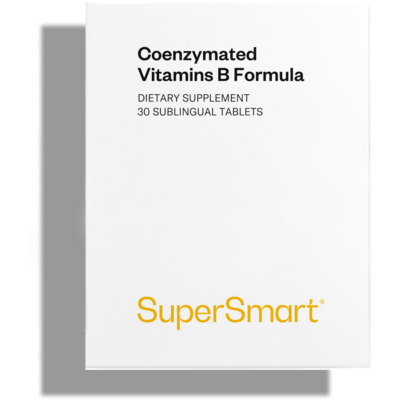
Coenzymated B vitamin complexes can offer improved absorption.
 Discover the Coenzymated B Vitamins supplement, which contains the full range of 8 B vitamins in their best forms.
Multivitamins can also be an option, making sure you stick to the recommended doses. Choose according to your needs:
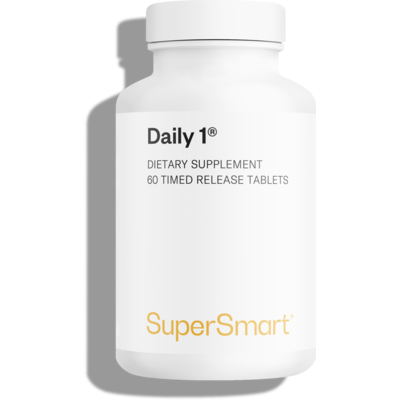
Discover the Daily 1 food supplement, which contains 30 exceptional vitamins, minerals and compounds.
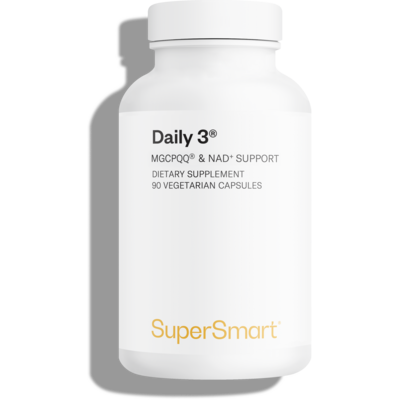
Discover Daily 3, a complete multivitamin formula with 45 ingredients (including 16 vitamins and 9 minerals).
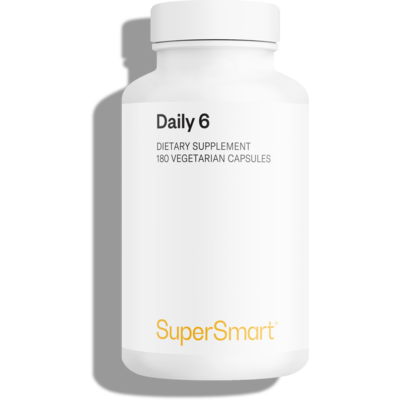
Discover Daily 6, an enriched version of Daily 3 with 54 ingredients in natural forms.
Good to know: It is recommended to consult a health professional before starting any supplementation, in order to assess individual needs and avoid any risk of overdosing.
SUPERSMART ADVICE
References
- Hrubša M, Siatka T, Nejmanová I, Vopršalová M, Kujovská Krčmová L, Matoušová K, Javorská L, Macáková K, Mercolini L, Remião F, Máťuš M, Mladěnka P, On Behalf Of The Oemonom. Biological Properties of Vitamins of the B-Complex, Part 1: Vitamins B1, B2, B3, and B5. Nutrients. 2022 Jan 22;14(3):484. doi: 10.3390/nu14030484. PMID: 35276844; PMCID: PMC8839250.
- Ashoori M, Saedisomeolia A. Riboflavin (vitamin B₂) and oxidative stress: a review. Br J Nutr. 2014 Jun 14;111(11):1985-91. doi: 10.1017/S0007114514000178. Epub 2014 Mar 20. PMID: 24650639.
- Powers HJ. Riboflavin (vitamin B-2) and health. Am J Clin Nutr. 2003 Jun;77(6):1352-60. doi: 10.1093/ajcn/77.6.1352. PMID: 12791609.
- https://www.cerin.org/articles/references-nutritionnelles-pour-les-adultes/
- Whitfield KC, da Silva L, Feldman F, Singh S, McCann A, McAnena L, Ward M, McNulty H, Barr SI, Green TJ. Adequate vitamin B12 and riboflavin status from menus alone in residential care facilities in the Lower Mainland, British Columbia. Appl Physiol Nutr Metab. 2019 Apr;44(4):414-419. doi: 10.1139/apnm-2018-0459. Epub 2018 Sep 24. PMID: 30248270.
Keywords




1 Days
correct product arrived on time
The product arrived on time and appears to be what I ordered (i do not perform any tests outside of my own experience). I have used this Bacillus Subtills for quite over a year, and I am convinced of it's contribution to my microbiome. The product and business model work well.
Lisa
1 Days
All the supplements are of great…
All the supplements are of great quality and they have almost anything you could need
kirstin Torres
1 Days
Easy to order, fast delivery
Easy to order, fast
Sissy Lawson
5 Days
What luck to come across such a clean…
What luck to come across such a clean brand! No bad ingredients in these and a reasonable price for what we're getting.
Bindi S
6 Days
The best supplement for…
The best supplement for hyperpigmentation or melasma. I have struggled with melasma and hyperpigmentation for 10 years. I have tried everything, including lasers. Nothing really worked except this!
NS
9 Days
Great source for high quality…
Great source for high quality supplements
Vikki L
11 Days
Recommended: "Eye Pressure"
(Eye Pressure pills) Highly recommended for glaucoma patients
LM
12 Days
Great follow-up
Great follow-up
Michael Henderson
16 Days
My hair isn't gray.
My hair isn't gray.
TANQUARY Damon
16 Days
The ease of ordering is not the only …
The ease of ordering is not the only reason why I trust Super Smart Supplements. This company researches everything they sell. Educating Me with a wealth knowledge to make Better Supplement choices. The paractin Andrographis is awesome! I noticed less Knee, shoulder or joint pain. Which proves to me, you're never too old to repair what a lifetime of intense usage has done to your body. I recommend SUPER SMART to anyone who is looking to improve their overall health & maintain an active ,pain free life as You age.
Mchael Montalbano
19 Days
Quick shipping and very good quality
Quick shipping and very good quality. I’ve bought from them for the last six months
Monig
22 Days
love the quality of the supplements!
love the quality of the supplements!
Tatiana
24 Days
Came quickly
Came quickly
Courtney Everson
24 Days
Feels great on my skin
I have only used the SuperSmart NAD face cream for a couple of weeks. So I can’t say it transformed my skin yet. However, it absorbs nicely. Is not oily or caused any acne. It feels wonderful in my routine which means I will consistently use every day! I’ve already researched the ingredients so I’m confident it will help clear the zombie cells and keep my skin looking fresh. I’m pleasantly surprised and will repurchase!
Moto
27 Days
Excellent quality
Excellent quality, I can usually tell the difference when I get other cheaper brands that are not as good. Supersmart is my first choice
MMA TUBE