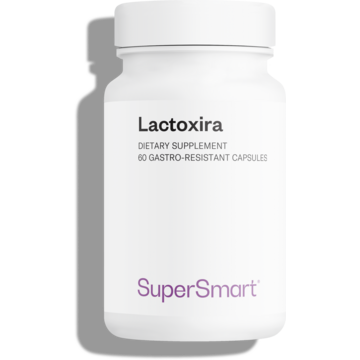
Lactoxira is an advanced psychobiotic formulation inspired by current research on the gut–brain axis. Scientists now recognize that microorganisms in the digestive tract interact with the brain through neurotransmitter pathways and signaling molecules, playing a role in emotional balance and overall well-being.*
These insights highlight how microbiota composition may influence daily emotional resilience, mindset, and general mental well-being.*
Who Is Lactoxira For?
Lactoxira is intended for individuals seeking nutritional support for emotional balance, motivation, and everyday mental clarity.* It may be helpful for those who:
- Experience occasional fluctuations in mood or motivation.*
- Wish to support a positive mindset and emotional resilience during demanding periods.*
- Want to nurture a healthy connection between gut wellness and emotional well-being.*
The formula may also appeal to individuals whose lifestyle habits—such as stress, limited sleep, or dietary imbalances—could influence overall emotional wellness.*
How May Lactoxira Support Emotional Well-Being?*
Probiotics help maintain a balanced microbiota, which is increasingly recognized for its potential influence on emotional and cognitive processes.* Research explores two main areas of interest:
1. The Gut–Brain Axis
Certain probiotic strains can produce or interact with compounds involved in normal neurotransmitter activity.* These interactions support pathways connected to calmness, focus, and emotional steadiness.*
2. Support for a Balanced Inflammatory Response*
A healthy microbiota helps maintain gut barrier integrity and supports normal inflammatory balance, contributing to overall emotional well-being.*
What’s Inside Lactoxira?
Lactoxira features well-studied probiotic strains selected for their roles in supporting emotional balance, cognitive well-being, and gut–brain communication.* These include:
- Bifidobacterium longum*
- Lactobacillus plantarum*
- Bifidobacterium bifidum*
- Bifidobacterium lactis*
- Lactococcus lactis*
- Lactobacillus casei*
- Lactobacillus brevis*
- Lactobacillus salivarius*
The strains are delivered in gastro-resistant capsules designed to help them reach the intestinal environment. Each serving contains more than 100 billion CFU to support a balanced and diverse microbiota.* Prebiotics are also included to help nourish beneficial bacteria.*
Why Consider Lactoxira?*
- Supports emotional balance and day-to-day resilience.*
- Helps maintain a healthy and diverse microbiota.*
- Provides strains associated with neurotransmitter pathways involved in emotional and cognitive processes.*
- Supports the body’s natural inflammatory balance.*
- Delivers the general wellness benefits associated with probiotics, including digestive comfort.*
How to Maximize the Potential Benefits of Lactoxira?*
For best results, consider pairing the supplement with simple lifestyle habits that support emotional and microbiota health.*
1) Prioritize Dietary Fiber
Fiber-rich fruits, vegetables, and whole grains help nourish beneficial gut bacteria.*
2) Support a Balanced Lifestyle
Adequate sleep, stress management, and regular routines encourage overall well-being.*
3) Incorporate Relaxation Practices
Relaxation techniques may help support calmness and emotional steadiness.*
4) Increase Physical Activity
Regular movement helps support emotional vitality and cognitive function.*
Drawing on current scientific insights, Lactoxira provides targeted support for individuals seeking to maintain emotional balance, nurture a healthy microbiota, and encourage optimal gut–brain communication.*
WARNINGS
Do not exceed the recommended daily dose. This product is a nutritional supplement and should not be used as a substitute for a varied and balanced diet or a healthy lifestyle.
STORAGE
Store in a cool, dry place away from direct sunlight, heat, and humidity.
Keep out of reach of children.
PREGNANCY AND MEDICAL CONDITIONS
If you are pregnant, breastfeeding, or have any medical conditions, consult your healthcare provider before using this product.
SUPPLEMENT INTERACTIONS
Consult your healthcare provider before use, especially if you are taking any medications or other supplements as there may be potential interactions.
*These statements have not been evaluated by the Food and Drug Administration. This product is not intended to diagnose, treat, cure, or prevent any disease.
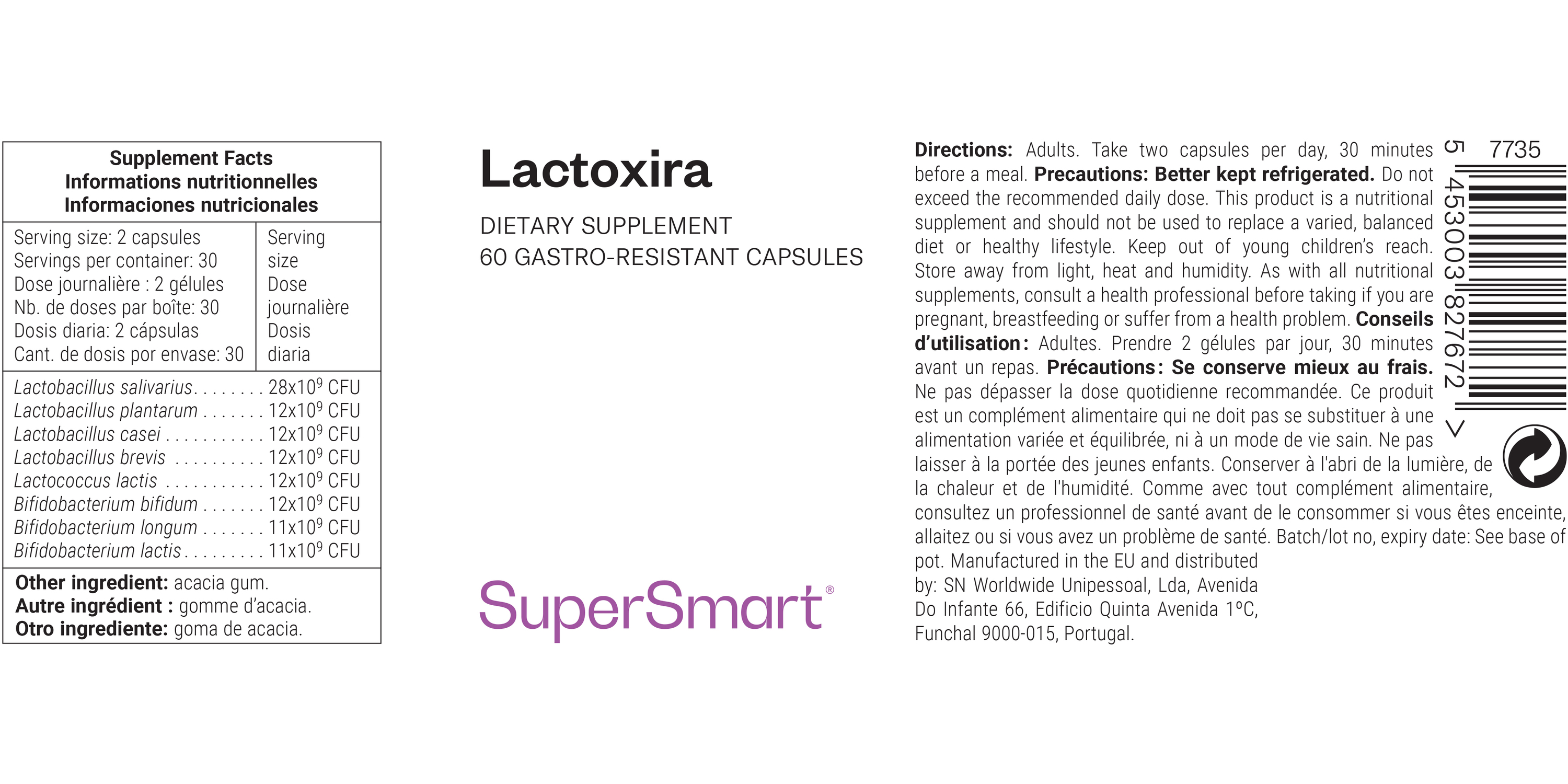
Serving Size: 2 Capsules
Servings Per Container: 30 |
Amount Per Serving |
| Lactobacillus salivarius |
28 × 109 CFU |
| Lactobacillus plantarum |
12 × 109 CFU |
| Lactobacillus casei |
12 × 109 CFU |
| Lactobacillus brevis |
12 × 109 CFU |
| Lactococcus lactis |
12 × 109 CFU |
| Bifidobacterium bifidum |
12 × 109 CFU |
| Bifidobacterium longum |
11 × 109 CFU |
| Bifidobacterium lactis |
11 × 109 CFU |
|
Other Ingredient: Acacia Gum.
|
Serving size: Take 2 capsules a day, 30 minutes before a meal.
Servings per container: 30
Storage: Better kept refrigerated.
Cautions: For adults only. Do not exceed the recommended daily dose. Keep out of reach of children. Consult a healthcare provider before taking this supplement and if you are pregnant, breastfeeding, or having health concerns.*
This product is a dietary supplement and should not be used as a substitute for a varied, balanced diet and a healthy lifestyle.
- World Health Association: Health and nutritional properties of probiotics in food including powder milk with live lactic acid bacteria. Geneva, Switzerland, World Health Association
- Ritchie ML, Romanuk TN: A meta-analysis of probiotic ... . PLoS One 2012; 7:e34938
- McFarland LV: Meta-analysis of probiotics for the ... . Am J Gastroenterol 2006; 101:812–822
- Hoveyda N, Heneghan C, Mahtani KR, et al: A systematic review and meta-analysis: probiotics in the ... . BMC Gastroenterol 2009; 9:15
- Khalesi S, Sun J, Buys N, et al: Effect of probiotics on blood ... : a systematic review and meta-analysis of randomized, controlled trials. ... 2014; 64:897–903
- Cuello-Garcia CA, Brozek JL, Fiocchi A, et al: Probiotics for the ... of allergy: A systematic review and meta-analysis of randomized controlled trials. J Allergy Clin Immunol 2015; 136:952–961
- Bravo JA, Forsythe P, Chew MV, et al: Ingestion of Lactobacillus strain ... emotional behavior and central GABA receptor expression in a mouse via the vagus nerve. Proc Natl Acad Sci USA 2011; 108:16050–16055
- Dash S, Clarke G, Berk M, et al: The gut microbiome and diet in ... : focus on ... . Curr Opin ... 2015; 28:1–6
- Wang, H., Lee, I. S., Braun, C., & Enck, P. (2016, October). ... probiotics on central nervous system functions in animals and humans: A systematic review. Journal of ... and Motility, 22(4), 589–605. doi:10.5056/jnm16018
- Dinan TG, Stanton C, Cryan JF (2013) Psychobiotics: a novel class of psychotropic. Biol ... 74(10):720–726
- Schousboe A, Waagepetersen HS (2007) GABA: homeostatic and pharmacological aspects. In: Tepper JM, Abercrombie ED, Bolam JP (eds) GABA and the basal ganglia: from molecules to systems, vol 9–19. Elsevier Science B, Amsterdam
- Roshchina VV (2010) Evolutionary considerations of neurotransmitters in microbial, plant, and animal cells. In: Lyte M, Freestone PPE (eds) Microbial ... : interkingdom signaling in ... and health. Springer, New York, pp 17–52
- Collins SM, Bercik P (2009) The relationship between intestinal microbiota and the central nervous system in ... . Gastroenterology 136:2003–2014
- Bested AC, Logan AC, Selhub EM: Intestinal microbiota, probiotics and ... : from Metchnikoff to modern advances, part II: contemporary contextual research. Gut Pathog 2013; 5:3–3
- Logan AC, Katzman M: ... : probiotics may be an adjuvant ... . Med Hypotheses 2005; 64:533– 538
- Desbonnet L., Garrett L., Clarke G., Bienenstock J., Dinan T.G. The probiotic Bifidobacteria infantis: An assessment of potential ... properties in the rat. J. Psychiatr. Res. 2008;43:164–174. doi: 10.1016/j.jpsychires.2008.03.009.
- Wium-Andersen MK, Ørsted DD, Nielsen SF, et al: Elevated C-reactive protein levels, ... in 73,131 individuals. JAMA Psychiatry 2013; 70:176–184
- Cepeda MS, Makadia R: ... is associated with high levels of C reactive protein and low levels of exhaled nitric oxide: results from the 2007–2012 National Health and Nutrition Examination Surveys. J Clin ... (Epub ahead of print, June 21, 2016)
- Berk M, Williams LJ, Jacka FN, et al: ..., but where does the ... come from? BMC Med 2013; 11:200
- Maes M, Kubera M, Leunis JC et al (2013) In ... , bacterial translocation may drive ... . Acta Psychiatr Scand 127(5):344–354
- Clarke G, Grenham S, Scully P et al (2013) The microbiome-gutbrain axis during early life ... the hippocampal serotonergic system in a ... manner. Mol Psychiatry 18(6):666–673
- Tillisch K, Labus J, Kilpatrick L, et al: Consumption of fermented milk product with probiotic ... brain activity. ... 2013; 144:1394–1401
- Mayer EA, Knight R, Mazmanian SK, et al: Gut microbes and the brain: paradigm shift in neuroscience. J Neurosci 2014; 34:15490– 15496
- Steenbergen L, Sellaro R, van Hemert S, et al: A randomized controlled trial to test the effect of multispecies probiotics on cognitive reactivity to ... . Brain Behav Immun 2015; 48: 258–264
- Messaoudi M, Lalonde R, Violle N, et al: Assessment of ... like properties of a probiotic formulation (Lactobacillus helveticus R0052 and Bifidobacterium longum R0175) in rats and human subjects. Br J Nutr 2011; 105:755–764
- Wang, H., Lee, I. S., Braun, C., & Enck, P. (2016, October). ... of probiotics on central nervous system functions in animals and humans: A systematic review. Journal of ... and Motility, 22(4), 589–605. doi:10.5056/jnm16018
- Perovic B, Jovanovic M, Miljkovic B, Vezmar S (2010) Getting the balance right: established and emerging ... for major ... . Nuropsychiatr Dis ... 7(6):343–364
- Evrensel A., Ceylan M.E. The Gut-Brain Axis: The Missing Link in ... . Clin. Psychopharmacol. Neurosci. 2015;13:239–244. doi: 10.9758/cpn.2015.13.3.239.
- Lai JS, Hiles S, Bisquera A, et al: A systematic review and metaanalysis of dietary patterns and ... in community-... adults. Am J Clin Nutr 2014; 99:181–197
- Hibbeln JR. Fish consumption and major ... . Lancet. 1998;351(9110):1213. Lettre; Texte intégral
- Jacka EN, Pasco JA, et al. Dietary omega-3 fatty acids and ... in a community sample.Nutr Neurosci. 2004 Apr;7(2):101-6.
- Mamalakis G, Tornaritis M, Kafatos A. ... and adipose essential polyunsaturated fatty acids. Prostaglandins Leukot Essent Fatty Acids. 2002;67(5):311-318.
- Tolmunen T, Hintikka J, et al. Dietary folate and the ... in Finnish middle-aged men. A prospective follow-up study. Psychother Psychosom. 2004 Nov-Dec;73(6):334-9.
- Papakostas GI, Petersen T, et al. The relationship between serum folate, vitamin B12, and homocysteine levels in major ... and the timing of improvement (etc.). Int J Neuropsychopharmacol. 2005 Dec;8(4):523-8. Erratum in: Int J Neuropsychopharmacol. 2005 Dec;8(4):528.
- Papakostas GI, Petersen T, et al. The relationship between serum folate, vitamin B12, and homocysteine levels in major ... and the timing of improvement (etc.). Int J Neuropsychopharmacol. 2005 Dec;8(4):523-8. Epub 2005 May 9. Erratum in : Int J Neuropsychopharmacol. 2005 Dec;8(4):528.
- Hou WH, Chiang PT, et al. ... of massage ... people: a meta-analysis. J Clin ... . 2010 Mar 23.
- Field T, Hernandez-Reif M, et al. ... and serotonin increase following massage ... . Int J Neurosci. 2005;115(10):1397-413.
- Brosse AL, Sheets ES, et al. Exercise and the ... in adults: recent findings and future directions. Sports Med. 2002;32(12):741-60. Review
- Lawlor DA, Hopker SW. The ... as an intervention in the management of ... : systematic review and meta-regression analysis of randomised controlled trials. BMJ. 2001 Mar 31;322(7289):763-7.