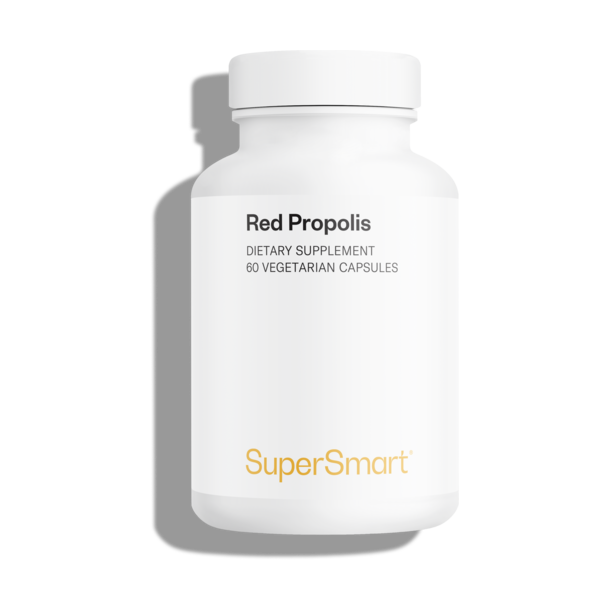
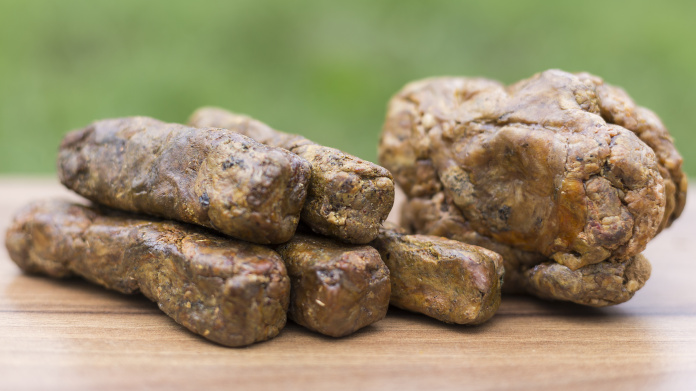
This supplement contains red propolis, a distinctive type of propolis harvested from the mangroves of Brazil. Red propolis is characterized by a unique botanical profile and a naturally occurring concentration of polyphenols and other plant-derived compounds.*
Red propolis is derived from resins collected by bees from the plant species Dalbergia ecastaphyllum. Its composition has been the subject of scientific interest due to its diverse array of naturally occurring phytochemicals.*
Red Propolis Extract Overview
Propolis has been used for centuries in traditional practices. Modern research focuses on understanding the chemical composition of red propolis and its role as a source of antioxidant and plant-derived compounds within dietary supplementation.*
Red propolis contains a broad spectrum of naturally occurring constituents, including polyphenols, flavonoids, and isoflavones, which contribute to its nutritional profile.*
- Contains a diverse range of naturally occurring polyphenols and flavonoids.*
- Provides antioxidant compounds that participate in cellular balance.*
- Included as part of a dietary supplement designed to support overall wellness.*
Why is Brazilian Red Propolis Distinctive?
Brazilian red propolis has a composition that differs from other propolis varieties due to the specific botanical environment in which it is produced. Its phytochemical profile reflects the unique plant sources available in Brazilian mangrove ecosystems.*
Analytical studies have identified a wide range of naturally occurring compounds in red propolis, including phenolic compounds, flavonoids, and trace elements commonly found in propolis-derived materials.*
- Polyphenols and flavonoids naturally present in red propolis.*
- Isoflavones contributing to its botanical profile.*
- Trace minerals naturally occurring in propolis.*
Where Does Red Bee Propolis Come From?
Propolis is a resinous material produced by bees using plant resins, wax, and enzymes. Bees use propolis within the hive as a structural and protective material.*
Red propolis is collected by beekeepers and carefully processed to remove impurities while preserving its natural composition. The resulting extract reflects a concentrated source of plant-derived compounds gathered by bees.*
In Brazil, bees collect resins primarily from Dalbergia ecastaphyllum, a climbing plant found in mangrove regions. This botanical source contributes to the distinctive color and composition of Brazilian red propolis.*
Red propolis differs from green propolis, which is produced from a separate botanical source (Baccharis dracunculifolia) and has a different phytochemical profile.*
Why Choose Red Propolis Capsules?
Red propolis capsules provide a convenient way to supplement with this distinctive form of propolis as part of a balanced diet and healthy lifestyle.*
- Derived from a specific botanical source unique to Brazilian ecosystems.*
- Delivered in capsule form for ease of use and consistency.*
- Processed using controlled extraction methods to preserve its natural composition.*
- Included as part of a wellness-focused dietary supplement routine.*
WARNINGS
Do not exceed the recommended daily dose. This product is a nutritional supplement and should not be used as a substitute for a varied and balanced diet or a healthy lifestyle.
STORAGE
Store in a cool, dry place away from direct sunlight, heat, and humidity.
Keep out of reach of children.
PREGNANCY AND MEDICAL CONDITIONS
If you are pregnant, breastfeeding, or have any medical conditions, consult your healthcare provider before using this product.
SUPPLEMENT INTERACTIONS
Consult your healthcare provider before use, especially if you are taking any medications or other supplements as there may be potential interactions.
*These statements have not been evaluated by the Food and Drug Administration. This product is not intended to diagnose, treat, cure, or prevent any disease.
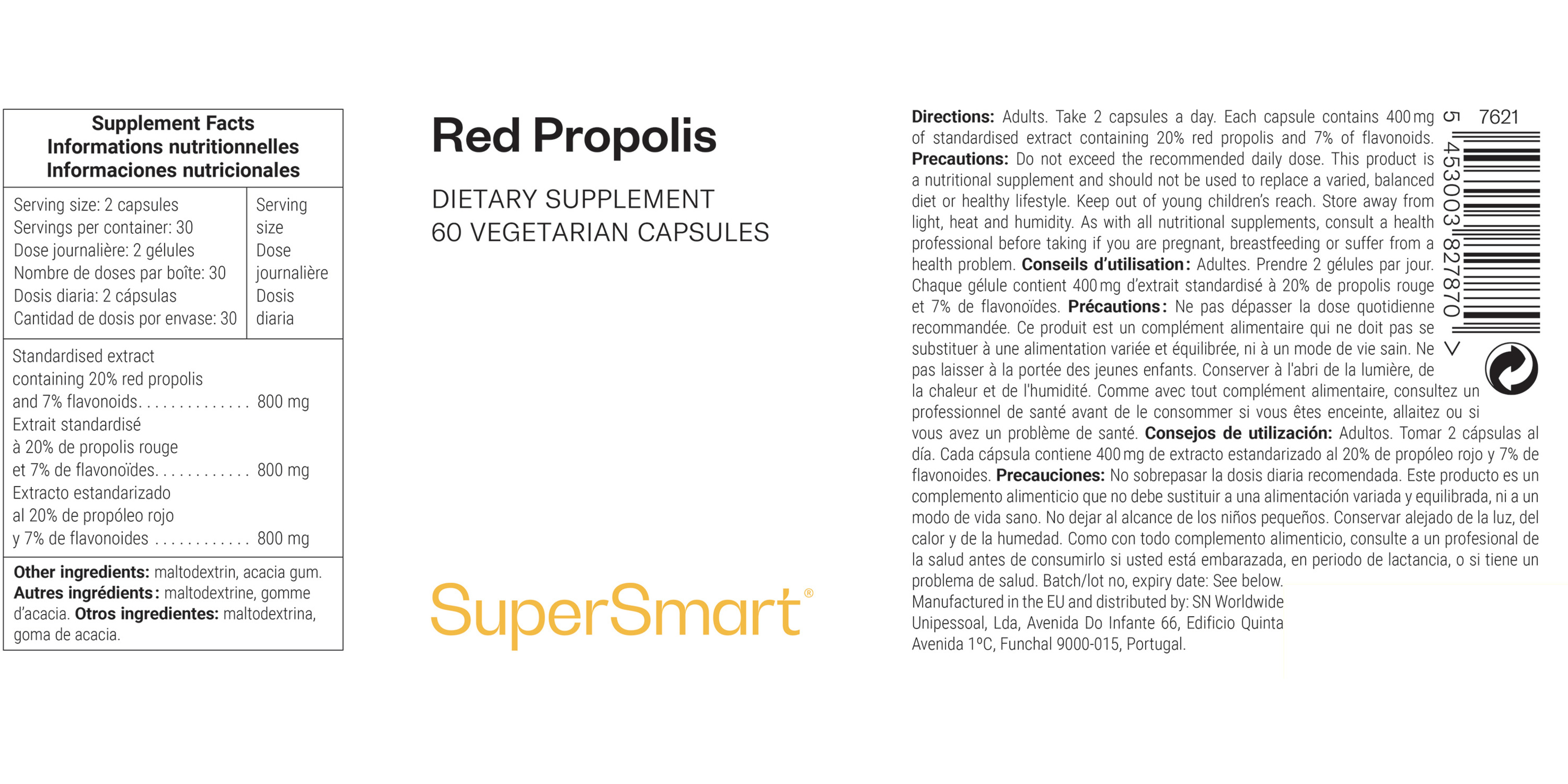
Daily dose: 2 capsules
Number of doses per pack: 30 |
Amount per dose |
| Standardized extract containing 20% red propolis and 7% flavonoids
|
800 mg |
| Other ingredients: maltodextrin, acacia gum. |
Serving size: Take 2 capsules a day.
Servings per container: 30
Storage: Store away from direct light, heat, and humidity.
Cautions: For adults only. Do not exceed the recommended daily dose. Keep out of reach of children. Consult a healthcare provider before taking this supplement and if you are pregnant, breastfeeding, or having health concerns.*
This product is a dietary supplement and should not be used as a substitute for a varied, balanced diet and a healthy lifestyle.
- Machado BAS, Silva RPD, Barreto GdA, Costa SS, Silva DFd, Brandão HN, et al. (2016) Chemical Composition and Biological Activity of Extracts Obtained by Supercritical Extraction and Ethanolic Extraction of Brown, Green and Red Propolis Derived from Different Geographic Regions in Brazil. PLoS ONE 11(1): e0145954. doi:10.1371/ journal.pone.0145954
- Park YK, Ikegaki M, Alencar SM, Moura FF. Evaluation of Brazilian propolis by both physicochemical methods and biological activity. Honeybe Sci 2000; 21: 85-90.
- Oldoni TLC, Cabral ISR, D'Arce MABR, Rosalen PL, Ikegaki M, Nascimento AM, et al. Isolation and analysis of bioactive isoflavonoids and chalcone from a new type of Brazilian propolis. Separat Purif Technol 2011; 77: 208-13.
- Corbellini Rufatto L. et al. Red propolis: Chemical composition and pharmacological activity, Asian Pac J Trop Biomed 2017; 7(7): 591–598
- Szliszka, E., Kucharska, A. Z., Sokół-Łętowska, A., Mertas, A., Czuba, Z. P., & Król, W. (2013). Chemical composition and ... of ethanolic extract of Brazilian green propolis on activated J774A.1 macrophages. Evidence-based Complementary and Alternative Medicine976415
- Viuda-Martos, M., Ruiz-Navajas, Y., Fernandez-Lopez, J., & Perez-Alvarez, J. A. (2008). Functional properties of honey, propolis, and royal jelly. Journal of Food Science, 73(9), R117–R124.
- Ngatu NR, Saruta T, Hirota R, Eitoku M, Muzembo BA, Matsui T, et al. ... of Brazilian green propolis extracts and honey on Tinea capitis and Tinea versicolor. Eur J Integr Med. 2011; 3(4): e281–e287. doi: 10.1016/j.eujim.2011.10.001
- Bufalo, M. C., Ferreira, I., Costa, G., Francisco, V., Liberal, J., Cruz, M. T., ... Sforcin, J. M. (2013). Propolis and its constituent caffeic acid ... by blocking NF-kappaB and MAPK activation in macrophages. Journal of Ethnopharmacology, 149, 84–92
- Franchi, G. C., Moraes, C. S., Toreti, V. C., Daugsch, A., Nowill, A. E., & Park, Y. K. (2012). Comparison of ... of the ethanolic extracts of Brazilian propolis on human ... as assessed with the MTT Assay. Evidence-based Complementary and Alternative Medicine918956 (6).
- Crisan I, Zaharia CN, et al. Natural propolis extract NIVCRISOL in the ... in children.Rom J Virol. 1995 Jul-Dec;46(3-4):115-33.
- Cohen HA, Varsano I, et al. ... of an herbal preparation containing echinacea, propolis, and vitamin C in ... in children: a randomized, double-blind, placebo-controlled, multicenter study.Arch Pediatr Adolesc Med. 2004 Mar;158(3):217-21.
- Machado BAS, Silva RPD, Barreto GdA, Costa SS, Silva DFd, Brandão HN, et al. (2016) Chemical Composition and Biological Activity of Extracts Obtained by Supercritical Extraction and Ethanolic Extraction of Brown, Green and Red Propolis Derived from Different Geographic Regions in Brazil. PLoS ONE 11(1): e0145954. doi:10.1371/ journal.pone.0145954
- Frozza, C. O.d. S., Santos, D. A., Rufatto, L. C., Minetto, L., Scariot, F. J., Echeverrigaray, S., ... Henriques, J. A. P. (2017). ... activity of Brazilian red propolis fractions ... cell line. Biomedicine & Pharmacotherapy, 91, 951–963.
- Trusheva B, Popova M, Bankova V, Simova S, Marcucci MC, Miorin PL, et al. Bioactive constituents of Brazilian red propolis. eCAM 2006; 3: 249-54.
- Balasundram N, Sundram K, Samman S. Phenolic compounds in plants and agri-industrial by-products: antioxidant activity, occurrence, and potential uses. Food Chem 2006; 99: 191-203.
- Cheynier V. Phenolic compounds: from plants to foods. Phytochem Rev 2012; 11: 153-77.
- Thimmappa R, Geisler K, Louveau T, O'Maille P, Osbourn A. Triterpene biosynthesis in plants. Ann Rev Plant Biol 2014; 65: 225-57.
- Marcucci MC. Propriedades biologicas e terap ´ euticas dos con- ˆ stituintes químicos da propolis. ´ Quím Nova 1996; 19: 529-36
- Pereira AS, Seixas FRMS, Aquino Neto FR. Propolis: 100 anos de ´ pesquisa e suas perspectivas futuras. Quím Nova 2002; 25: 321-6.
- Andrade, J. K. S., Denadai, M., de Oliveira, C. S., Nunes, M. L., & Narain, N. (2017). Evaluation of bioactive compounds potential and antioxidant activity of brown, green and red propolis from Brazilian northeast region. Food Research International, 101, 129–138. doi:10.1016/j.foodres.2017.08.066
- Piccinelli AL, Lotti C, Campone L, Cuesta-Rubio O, Campo Fernandez M, Rastrelli L. Cuban and Brazilian red propolis: botanical origin and comparative analysis by high-performance liquid chromatography-photodiode array detection/electrospray ionization tandem mass spectrometry. J Agric Food Chem 2011; 59: 6484-91.
- Clardy J, Walsh C. Lessons from natural molecules. Evid Based Complement Altern Med 2004; 432: 829-37.
- Silva BB, Rosalen PL, Cury JA, Ikegaki M, Souza VC, Esteves A, et al. Chemical composition and botanical origin of red propolis, a new type of Brazilian propolis. Evid Based Complement Altern Med 2007; 5: 313-6.
- Daugsch A, Moraes CS, Fort P, Park YK. Brazilian red propolischemical composition and botanical origin. Evid Based Complement Altern Med 2008; 5: 435-41
- López, B. G.-C., Schmidt, E. M., Eberlin, M. N., & Sawaya, A. C. H. F. (2014). Phytochemical markers of different types of red propolis. Food Chemistry, 146, 174–180.